
Conteúdo
You still hold the number three spot for a keyword you’ve owned for years. The page hasn’t moved in months, your traffic report says people are still finding it — and yet, the clicks through to your links have been sliding since spring.
Nothing broke. You didn’t get hit by an update. The roundup is still doing everything it always did, but it’s earning less for it.
Here’s what changed. Google’s AI Mode now answers “what’s the best X” right there in the results, building and recommending its own shortlist of products before a reader ever scrolls to your page.
In other words: consumers get the recommendation without the click, which means your affiliate link never gets clicked.
That’s happening to profissionais de marketing afiliados with product roundups in every niche, and the generic “best of” post is taking the hardest hit, because it’s the exact thing AI Mode is best at replacing.
The affiliates who keep earning through this are the ones getting more specific. Instead of one page fighting for a single broad keyword, they’re running several narrower pages built on real, firsthand experience, each one answering a question AI Mode can’t fully resolve on its own.
In this article, we’re covering why your roundups are losing clicks even when they still rank, what AI Mode rewards in their place, how to break one broad roundup into “best for” pages that get picked up, and how to keep a bigger, more targeted link library organized and profitable as you go.
Why Your “Best Of” Roundups are Losing Clicks Even When They Still Rank
The short version is that your roundup can hold its ranking and still lose the click, because ranking and getting clicked stopped being the same thing.
For example, when someone searches “best phone car mounts” now, Google’s AI Mode reads the top-ranking pages, pulls together its own shortlist, and presents it at the top of the results, complete with picks, quick reasoning, and product names:
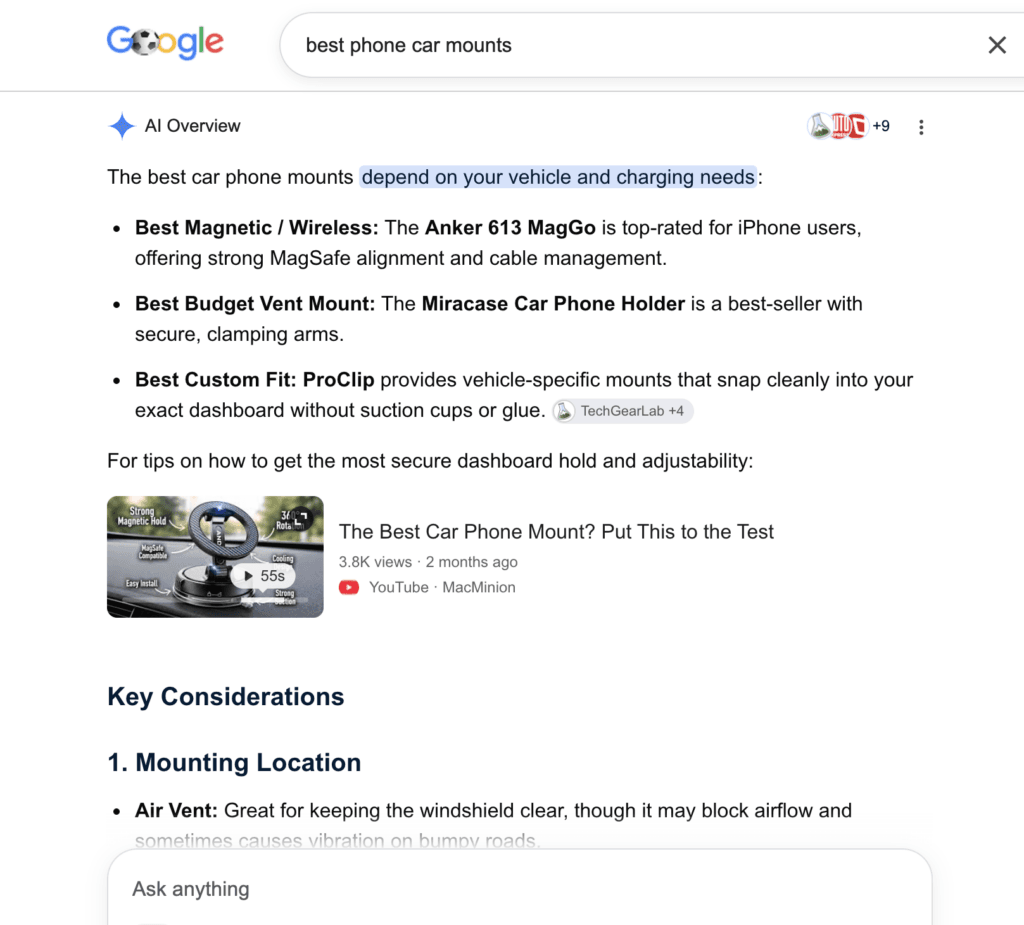
Your roundup might be one of the sources it drew from. The reader still gets their answer. They just get it from the results page instead of from you, and there’s no affiliate link inside an AI-generated summary for them to click.
It’s not only Google, either. Consumers are running the same requests through ChatGPT and other AI chatbots, asking them to compare two products, hunt down the best price, or recommend the one that solves a specific pain point.
Those are the exact jobs affiliate publishers built their businesses on. Except now the chatbot hands over the comparison or the recommendation directly, and the conversation ends before your link ever gets a look.
The broad roundup is the most exposed page in your content catalog. A list of ten products with a sentence or two on each is precisely the kind of content an AI model can read, condense, and hand back in seconds.
What AI Mode Rewards Now, and Why Specific Beats Generic
What still earns the click is content an AI answer can’t fully stand in for, and that comes down to two things: specificity and firsthand experience.
AI Mode is good at the broad question because the broad question has a broad, well-documented answer. Where it gets shakier is the narrow, situational question, the kind with fewer clean sources and more room for real judgment.
“Best phone car mount” has a tidy consensus answer. “Best phone car mount for a truck with a textured dash that a suction cup won’t stick to” does not. That gap is where specific content lives.
This lines up with how Google has said it evaluates content in the first place. Its guidance keeps pointing to Experience, Expertise, Authoritativeness, and Trust, the EEAT signals, with Experience doing a lot of the heavy lifting.
A page that shows someone actually used the product, in a real situation, with details you only get from handling it, reads as exactly the kind of firsthand source both readers and AI systems are looking for. A thin, generic page assembled from other people’s specs does not.
All that said, your specific content doesn’t disappear into the AI answer. It often becomes the source the AI answer is built on. Affiliate content is one of the biggest inputs feeding these AI recommendations, and the pages getting pulled in as citations are the detailed, experience-backed ones, not the generic lists.
So your work still gets surfaced. It just gets surfaced as the trusted source behind the answer, and a reader who wants the real, tested detail behind a one-line AI pick clicks through to get it.
Specific is also simply what readers respond to. A page that solves one narrow problem completely will beat a page that solves ten problems shallowly every time, because the reader with that one problem feels immediately like they’re in the right place.
How to Break One Broad Roundup Into “Best For” Pages that Get Picked Up by AI
Start with a resumo you already have, ideally one that used to earn and has been sliding.
Say it’s “The 10 Best Phone Car Mounts.” Right now that page is trying to be everything to everyone who drives with a phone, which is exactly why AI Mode can flatten it into three bullet points.
The move is to break it into pages that each answer one specific version of that question, built around the situations your readers actually bring to it.
For phone car mounts, those situations write themselves once you think about who’s searching:
- “Best phone car mounts for wireless charging“, for the reader who never wants to plug in.
- “Best MagSafe car mounts for iPhone“, for the reader whose phone snaps to a magnet.
- “Best phone car mounts for big phones“, for the Pro Max and foldable owners whose devices are too heavy for a cheap clamp.
- “Best phone car mounts under $30“, for the reader who wants a mount that holds up without overpaying.
- “Best no-dash phone mount for a Tesla“, for the reader whose car has nowhere obvious to put one.
Each of those is a page a shopper lands on already knowing they’re in the right place, and each one targets a search AI Mode is far less likely to answer completely on its own.
Then back every page with something a machine can’t fake: real use. Mounting the phone, driving with it, noting the one that rattled loose on a rough road and the one that held a foldable without sagging.
That firsthand detail is what earns the EEAT credit from the section above, and it gives a reader a reason to click past an AI summary to hear it.
Keep the original roundup, but change its job. Instead of competing for the head term on its own, it becomes the hub that links out to every “best for” page beneath it, catching the reader who’s still scoping their options and routing them to the specific page that fits.
Take the under-$30 page example. Your original roundup might have squeezed in two or three budget mounts before moving on.
A dedicated “best phone car mounts under $30” article needs a real lineup behind it: more options at that price, a few different brands, the alternatives you finally have room to line up. That way the reader who came for a budget pick can actually choose.
But here’s what you now have to keep in mind: Every product you add to fill it out is another affiliate link in your collection.
Run that across every page in the cluster, and it adds up fast. Each page earns its own fuller lineup, each new product is another link, and the ten your roundup started with becomes several times that.
And every one of them has to stay organized, tracked, and pointing somewhere that converts.
Using ThirstyAffiliates to Keep a Bigger, More Targeted Link Library Organized and Profitable
All those new product links are a good problem to have, right up until the library holding them turns into a pile you can’t navigate.
A specific-content strategy only works if the links underneath it stay organized, and that’s the part ThirstyAffiliates handles so the whole thing scales instead of turning into a mess.
Categorization keeps a growing library navigable
As one roundup becomes a cluster of specific pages, you don’t just have more links; you have more kinds of them: wireless chargers, MagSafe mounts, heavy-duty truck mounts, and every alternative and comparison pick you added along the way.
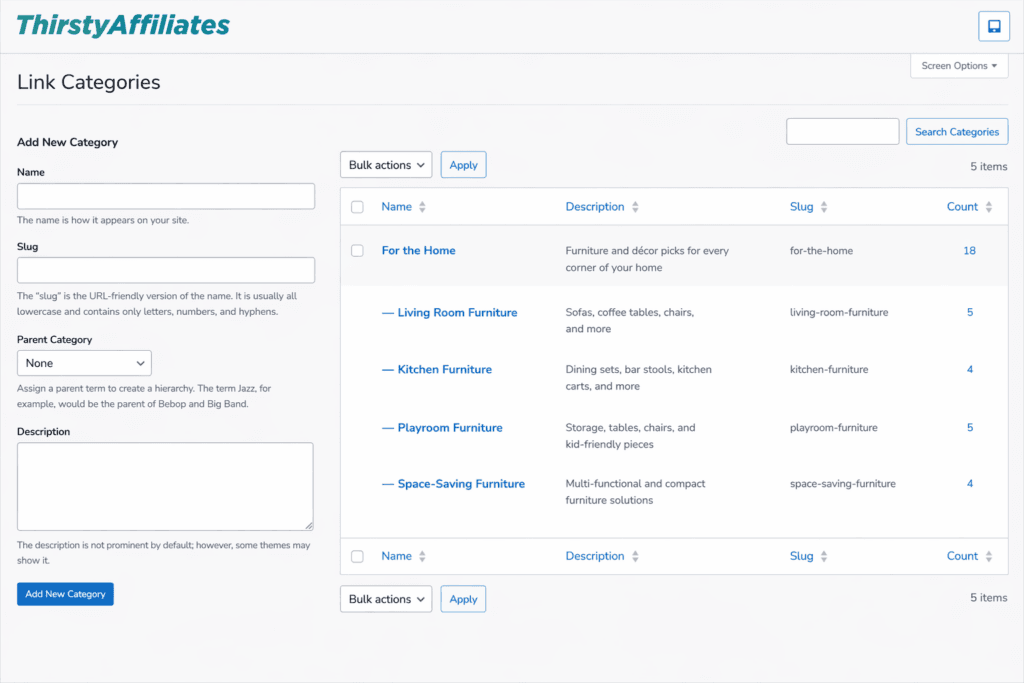
I group them so the dashboard mirrors how my content is actually organized, with a parent category for the cluster and subcategories by use case underneath.
When it’s time to write the next “best for” page or update an old one, I filter to that category and every relevant link is sitting there, instead of scrolling a flat list of two hundred URLs trying to remember which mount went where.
👉 Read more tips on Ways to Categorize your Affiliate Links with ThirstyAffiliates
The Automatic 404 Checker protects the links that matter most
More pages mean more links, and more links mean more chances one breaks when a merchant changes a URL or pulls a product.
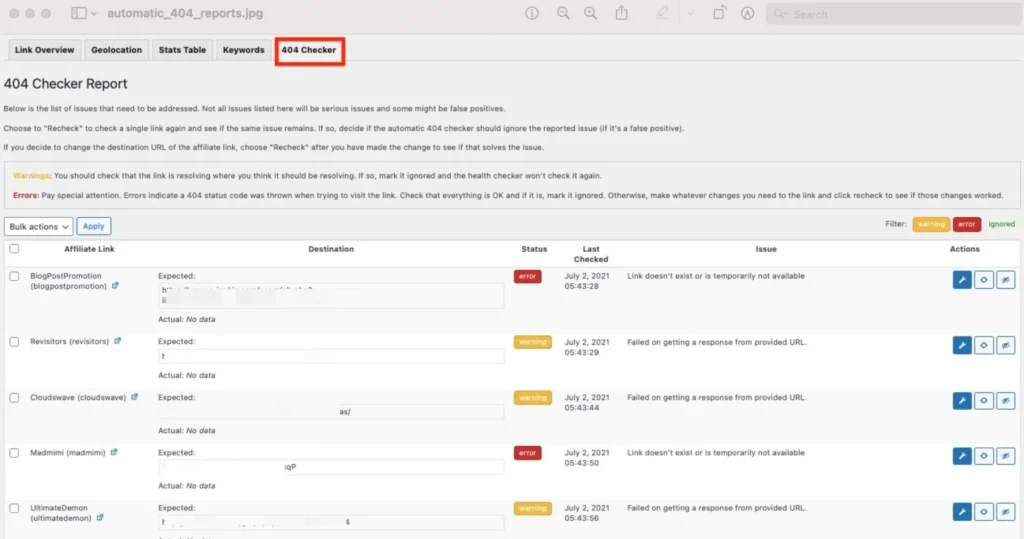
O ThirstyAffiliates’ Automatic 404 Checker scans every affiliate link on your site and flags the broken ones in a report under ThirstyAffiliates → Reports → 404 Checker, so you catch the break before it costs you a commission on your best-converting pages:
Cloaking keeps every new link clean and yours
Each “best for” page is one you want looking trustworthy, and a raw affiliate URL stuffed with tracking parameters does the opposite.
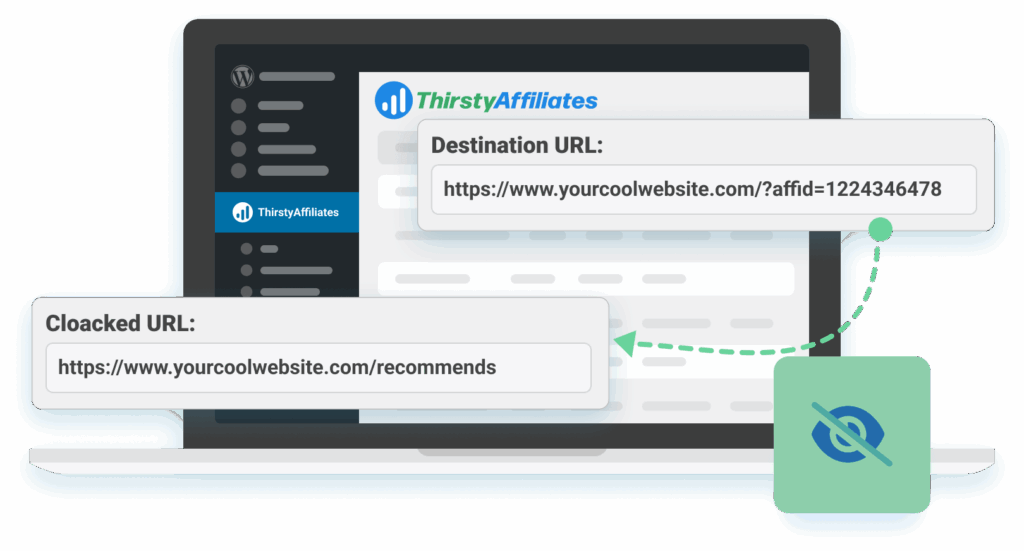
I cloak every link so it reads as mysite.com/recommends/magsafe-mount, branded to my site, instead of a merchant’s messy tracking string. The tracking itself stays fully intact behind the scenes.
Tracking and reporting tell me which “best for” pages to build more of
This is the one that closes the loop. ThirstyAffiliates tracks clicks on every link, so once your split pages are live, you can see which situations are actually converting
Maybe the wireless-charging page is steadily outperforming everything else, or the Tesla page barely gets traffic but converts nearly everyone who lands on it.
That data tells you where to aim next: more pages around the segments that earn, less effort on the ones that don’t.
Run it this way, and the infrastructure holds the strategy up. You can keep getting more specific, spinning up more targeted pages, without the link library becoming the thing that slows you down every time you sit down to write.
Conclusão
AI Mode didn’t kill affiliate content. It raised the bar on what earns the click, and the roundups paying the price are the generic ones that were always the easiest to replace.
The affiliates coming out ahead are doing three things:
- Breaking broad roundups into specific “best for” pages built around the real situations their readers have, so every page answers a question AI Mode can’t fully close on its own.
- Backing every page with firsthand experience, the tested, been-there detail that earns EEAT credit and gives a reader a reason to click past an AI summary to hear it.
- Keeping the bigger link library under control with categorization, 404 checking, cloaking, and click tracking, so getting more specific scales instead of turning into chaos.
Start with one roundup that used to earn and has been sliding. Split it into the handful of situations your readers actually search, back each one with real use, and give the whole cluster a categorized home in ThirstyAffiliates so nothing breaks or goes missing as it grows.
Adquira o ThirstyAffiliates hoje mesmo
Which of your roundups is the first one you’d split, and how many “best for” pages do you think are hiding inside it? Tell me in the comments.






Deixe um comentário
Você precisa fazer o login para publicar um comentário.