Conteúdo

It’s easy to build a content calendar topic-first, whether you’re jumping on the latest trend or you came across an up-and-coming keyword with decent volume and little competition.
When you spot an opening like that, you want to move fast and be among the first to cover it. So you write the post, get it published, and then scramble for an affiliate link that sort of fits the content you just put together.
That’s exactly how you end up with a blog collection full of articles that rank, pull in steady traffic, but don’t necessarily do anything for your income.
Planning offer-first flips that content strategy around — for the better. When you start with the offer you want to promote, brainstorm the post that will support it, and build a real user journey around it, you’re working from a much stronger setup.
The work gets easier because each post has a purpose: a product positioned for promotion. You’re never forcing an affiliate link into a post that wasn’t built to hold one. And in most cases, you’re still publishing just as often, but now every post is working toward a sale.
In this article, I’m going to walk you through how to decide which offers deserve your content, how to match each one to the kind of post that sells it, and how to build a calendar where every piece has a job to do for your affiliate revenue.
Start With the Offer, Then Find the Topic
If you’ve ever written an article first and then gone back to find a spot for your affiliate link, you know how that goes. You tweak a sentence here, rework a section there, and by the end you’ve basically rewritten the post around the offer anyway.
Starting in that order just means doing the work twice.
And that’s the better-case scenario. When the offer never makes it into the plan at all, it either gets dropped in with little context (which screams ad-pushing) or bolted onto the end of a post, where readers hardly ever reach it.
Either way, that’s hours of writing for a link that earns you nothing.
Lead with the offer instead, and both problems disappear. When you decide on the product before you write, the whole post is built to carry the reader toward it—what it does, how it ties into your topic, why it’s the solution—making the case to buy from the first line to the last.
But leading with the offer only works if you know what’s in your lineup to begin with, and that’s easiest when every offer you promote sits in one place you can scan at a glance.
A link category for every offer inside ThirstyAffiliates puts them there. Open your categories and your full lineup is laid out in front of you, ready to plan against.
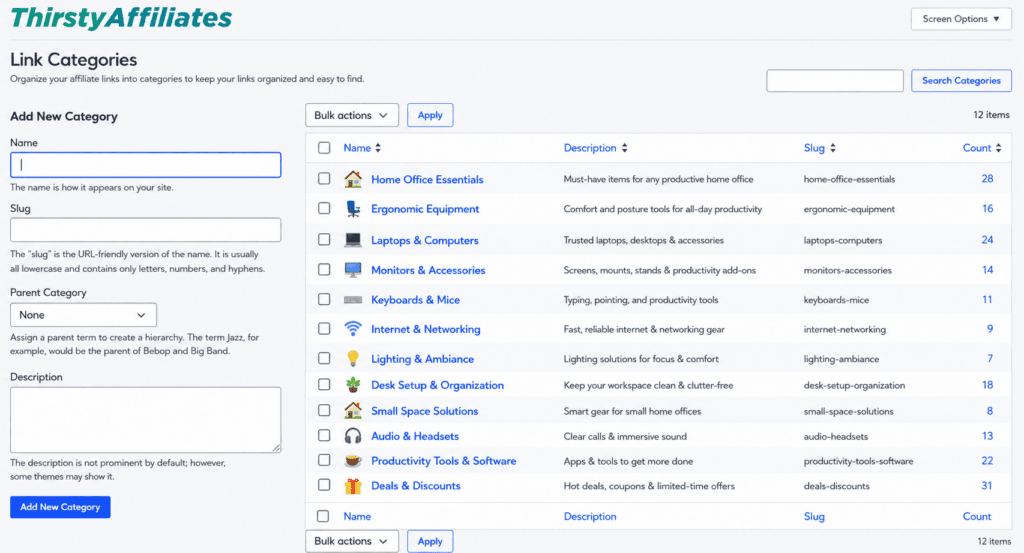
⚒️ Set it up once: Create link categories in ThirstyAffiliates to help keep your affiliate links organized from day one. Every link you add drops into its category, so your whole collection stays sorted and ready to grab the moment you need it.
Decide How Much Content Each Offer Earns
With the offer chosen, the next question becomes how much content to build around it, because not every product earns the same-sized cluster.
Some deserve a steady run of posts working together, while others are worth a single piece until they prove themselves. Which one you’re looking at comes down to what you already know about the product.
Let the Data Lead for Products You Already Promote
For a product you’ve been promoting for a while, let the numbers make the call. ThirstyAffiliates shows you how many clicks a product’s links are pulling in, so you can weigh the attention it’s getting against what it actually earns.
The clearest win is a product that converts well, but only lives in a post or two. It’s already proven it can sell; however, you’re barely giving readers a path to it—so that’s a cluster waiting to be built, with more posts, more angles, and more ways into the same offer.
Low engagement takes a little more reading. If a product is falling flat but barely has any content behind it, you haven’t given it a fair shot yet—more content, or a different kind of content, might be what it needs to catch on.
But if you’ve already put plenty of posts behind it and it’s still going nowhere, that’s your sign that the content isn’t the issue, and piling on more won’t fix it.
Let Your Goals Lead for a Brand-New Offer
A brand-new offer doesn’t hand you any of that history, so the call comes down to your goals for it instead. How much are you betting on this one?
When you’ve got real confidence in an offer—when it hits everything that makes a product worth promoting in the first place—it’s likely worth a full cluster from the start.
If you want to test the waters, it’s worth holding back a bit. A single post may be enough to put the offer in front of readers and see how they initially respond.
Give that first piece a little time to gather data, and you’ll have the same numbers your established products give you to work from—and the cluster can grow from there.
Match Each Offer to the Post that Sells It
Once you have a better sense of how much content an offer earns—and how much effort you’re putting in to match it—the next decision is what those posts should actually be.
Because a cluster only works when each piece pulls a different kind of reader toward the same offer. And those readers are rarely in the same place when they find you.
Some are weighing their options, some want to see the product work before they trust it, and some just want a shortlist someone already vetted for them.
The format you choose is how you meet each of them where they are and carry them toward the offer.
- Avaliações de produtos are your honest, deep-dive take on a single offer, covering the features, the benefits, and what it’s actually like to use. That thoroughness is what also makes it an evergreen earner, useful to any reader at any stage.
- Tutorials and how-to posts put an offer in action, walking a reader through getting something done with your offer as the tool that makes it click.
- Use-case posts drop an offer into a reader’s shoes. Rather than explaining what a product does in general, you show it in their exact situation.
- Comparison posts settle the “which one” for a reader who’s already decided to buy and is just stuck between options.
- Roundups and best-of posts cut through a crowded category for readers who want a shortlist, narrowing a dozen options down to the pick worth their money.
It’s likely you won’t need all five affiliate content types for a single offer. Simply lead with the format that best fits how people tend to shop for that kind of product, get it out there, and let the clicks guide you toward which ones are worth writing next.
Build Your Publishing Calendar with Strategy Behind It
When you have a handful of posts written and ready to go, the only thing left is getting them out to your readers. That part feels simple, just pick a day and hit publish.
But the dates you give those posts, the order you publish them in, and the room you leave between them all play a part in how much they actually earn.
There are a few moving parts worth getting right here, and together they keep your offer in front of the right readers at the right moments.
Time It Around Reader Buying Habits
Some of your posts have a natural moment to go live, when readers are already thinking about buying. Those moments are often timed around:
- Seasonal demand. Plenty of products sell on a calendar of their own, with predictable spikes around holidays; think New Year’s resolutions, back-to-school shopping, Black Friday, etc. Your buying guides and reviews should be live and ranking before those waves hit.
- Industry moments. Your niche has its own flashpoints too; a viral trend, a product everyone suddenly has an opinion on. These windows open and close fast, so timing a post to go live while the conversation’s still happening puts you in front of an audience that’s already paying attention.
- Promotions worth planning around. When an affiliate product you promote is on sale, that’s an opportunity to build your own campaign around too. Get your supporting post(s) live in the days before it starts, so readers are already sold on the product by the time the deal goes live and the discount is just the final push.
Space Them Out to Keep the Offer in View
When there’s no “event” setting the schedule for you, a steady publishing cadence does the job instead.
Pushing your whole cluster out in one week gives you a quick burst of attention and then a long stretch of silence.
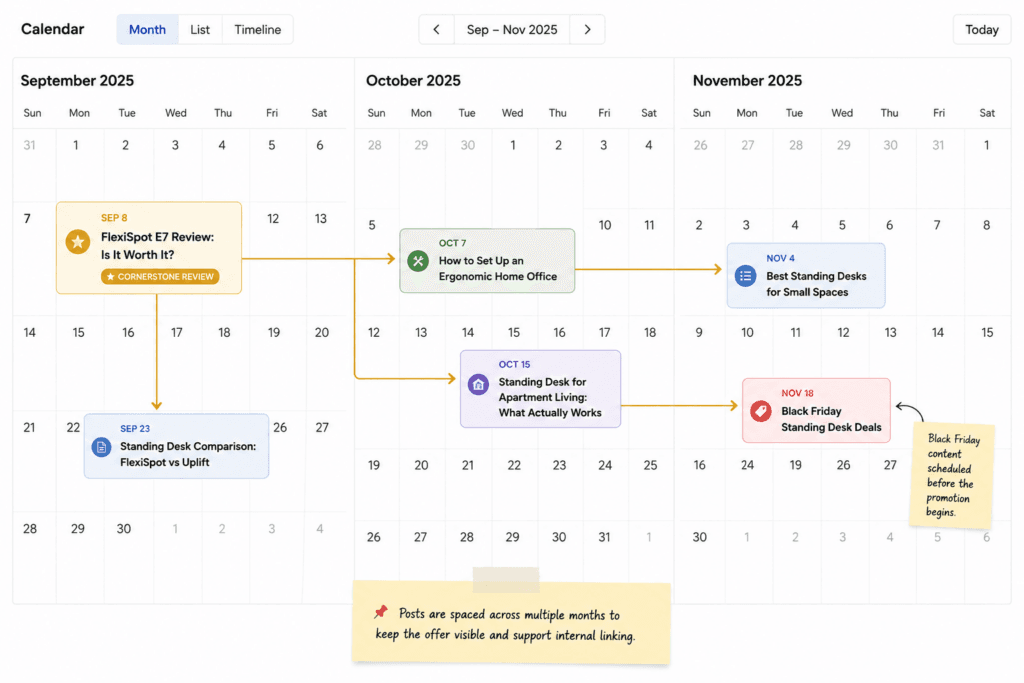
Spreading those posts over weeks or months keeps the offer resurfacing again and again, reaching new readers as they come across your content and showing search engines you’re consistently active on the topic.
Start by researching the best days and times to publish, then hold those numbers up against the traffic you already see on your blog to see if they work for you.
But past that, what you’re really after is rhythm and consistency. Post often enough that the offer stays in front of people, regular enough that readers know when your next one is coming, and spaced enough that each gets its own room to breathe and rank before the next goes up.
Order Your Posts So They Connect
Publishing order matters most because of what it lets your posts do for each other. The posts in a cluster are built to link together, but you can only link to a post that’s live. Which means the order you publish in decides what’s actually available to link to.
That’s why you typically want to push out your cornerstone piece first. It’s the fullest picture of the offer and the destination the rest of the cluster funnels toward. With it live, every supporting post you publish has somewhere intentional to send its traffic.
From there, internal linking is how you map the full buyer’s journey onto your content. Each type of post you wrote sits at a different stage, and you link each one down toward the next:
Roundup Listsicals
Give readers scoping their options a shortlist to choose from
↓
Comparisons
Guide the ones deciding between top picks
↓
Tutorials & How-Tos
Catch people who want to learn how to use a product
↓
Use-Cases
Show readers the product solving their exact situation
↓
Your Cornerstone Review
Where the decision to buy often gets made
Build it this way, and you haven’t just published a handful of posts. You’ve engineered a funnel that sells for you, turning a curious reader into a buyer one article at a time.
Conclusão
You don’t have to overhaul your whole calendar to put any of this to work. Start with one offer, and run it through the four moves we covered in the post:
- Start with the offer. Pick a product you already promote, or one you’ve been wanting to add.
- In ThirstyAffiliates, give that link a categorized home as you add it, so it stays organized alongside the rest of your collection.
- In ThirstyAffiliates, give that link a categorized home as you add it, so it stays organized alongside the rest of your collection.
- Decide how much content it earns. Take an honest look at what it brings in now, or what you’re hoping it will, and let that set how big its cluster should be.
- ThirstyAffiliates click data shows you which offers are already pulling readers, so the call is based on real numbers, not a guess.
- ThirstyAffiliates click data shows you which offers are already pulling readers, so the call is based on real numbers, not a guess.
- Match each post to the right reader. Map out the pieces that move a reader from curious to convinced, choosing the affiliate content that fits where each reader is.
- Build the calendar. Line those posts up by timing and order, so each one goes live at the right moment and feeds into the next.
Do it again with your next offer, and then the one after that. The more you repeat it, the more your affiliate revenue stacks up, with each new article earning on its own while you move on to build the next, until every piece in your blog collection ends in a conversion.